
Training Course: “Data Science and Artificial Intelligence Applied to Geosciences and Environmental Sciences” at ENSEGID
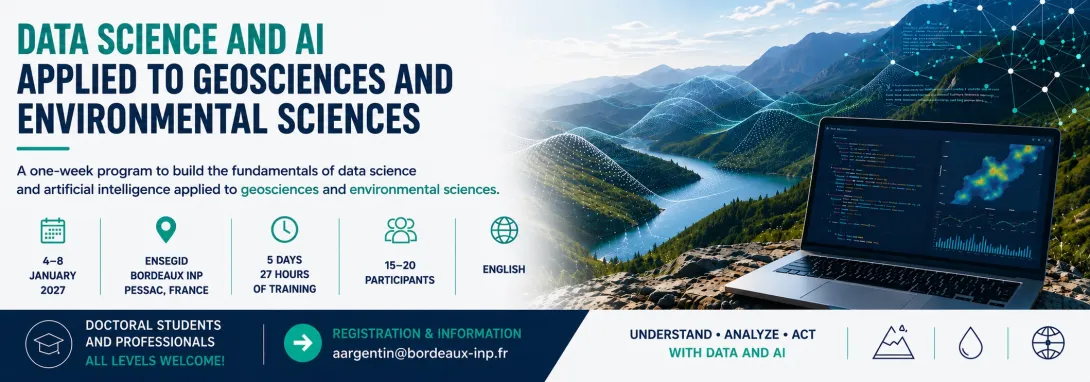
As data science and artificial intelligence play an increasingly important role in the geosciences and environmental sciences, ENSEGID is launching a new short course on Data Science and AI for Geosciences and Environmental Sciences, taking place from 4 to 8 January 2027.
This intensive one-week programme is designed for doctoral candidates, master’s students and professionals wishing to acquire the fundamental knowledge required to understand, analyse and effectively use data science and IA tools within their academic or professional activities.
A course dedicated to emerging data-driven approaches in geosciences
Today, geosciences generate ever-increasing volumes of data from field measurements, sensors, imagery, numerical models and geographic information systems. Making effective use of these data has become a key challenge for understanding natural processes, managing resources and supporting decision-making.
In this context, Data Science and Artificial Intelligence methods are playing an increasingly important role. However, their implementation requires a sound understanding of data, models and their limitations.
By the end of the programme, all participants will be able to understand data-processing workflows, critically interpret results. Professionals will be better equipped to effectively collaborate with data scientists and modelling specialists; doctoral candidates and students will have the foundations to start applying these methods in their own research.
Skills and autonomy for research and professional practice
Upon completion of the course, participants will be able to:
- understand the main stages of a data-processing workflow, from acquisition to modelling;
- identify the most appropriate methods for a given geoscientific problem;
- assess the performance and limitations of machine learning models;
- critically interpret results produced by artificial intelligence methods;
- communicate effectively with data scientists, modellers and data engineers;
- take their first independent steps in applying data science and AI methods to their own research or professional projects.
The objective is not to train AI specialists in a few days, but rather to provide participants with the foundations needed to integrate these tools effectively into professional and research contexts.
A progressive programme combining theory and practical applications
Delivered over five days and comprising 27 hours of instruction, the course combines lectures and feedback from professionals working in geoscience and enrinonmental sectors.
Topics covered include:
- fundamentals of the data ecosystem;
- data cleaning and preparation;
- basics of databases and data management;
- exploratory data analysis and data visualisation;
- principles of machine learning;
- fundamentals of deep learning;
- critical evaluation of models;
- introduction to digital twins and the integration of physical knowledge into AI models.
Instructors
The course is coordinated by Anne-Laure Argentin, lecturer at ENSEGID - Bordeaux INP and researcher at the EPOC Laboratory (CNRS UMR 5805). Classes will be delivered by ENSEGID faculty members and researchers, and will be complemented by guest speakers from industry and research, illustrating real-world applications in fields such as hydrology, water resource management, the oil and gas sector, and environmental modelling, providing participants with practical insights into current challenges and professional practices.
Practical information
Dates: 4 - 8 January 2027
Location: On-site at ENSEGID, Pessac (France) - [ Campus map - search Bordeaux INP - ENSEGID ]
Format: In-person - 27 hours of training
Language: English (course materials in English)
Number of participants: 15 - 20
Application deadline: 30 October 2026
Applications will be reviewed on a rolling basis - early submission is encouraged, particularly for participants travelling from abroad.
Fees
- PhD students (all institutions) and self-funded participants: €450
- Professionals funded by their organisation: €700
Registration fees include course materials, access to the datasets used during the training sessions, and a certificate of attendance.
Application requirements
Applicants are invited to submit:
- Full name and affiliated institution/organisation;
- Status: PhD student, professional, or other;
- Research topic or area of expertise;
- Python proficiency level: beginner, intermediate, or advanced;
- Curriculum vitae (CV);
- Cover letter outlining your current research or professional context, your motivation for attending the course, and the objectives you hope to achieve through participation.
Applications and Contact
Anne-Laure ARGENTIN : aargentin@bordeaux-inp.fr
Document