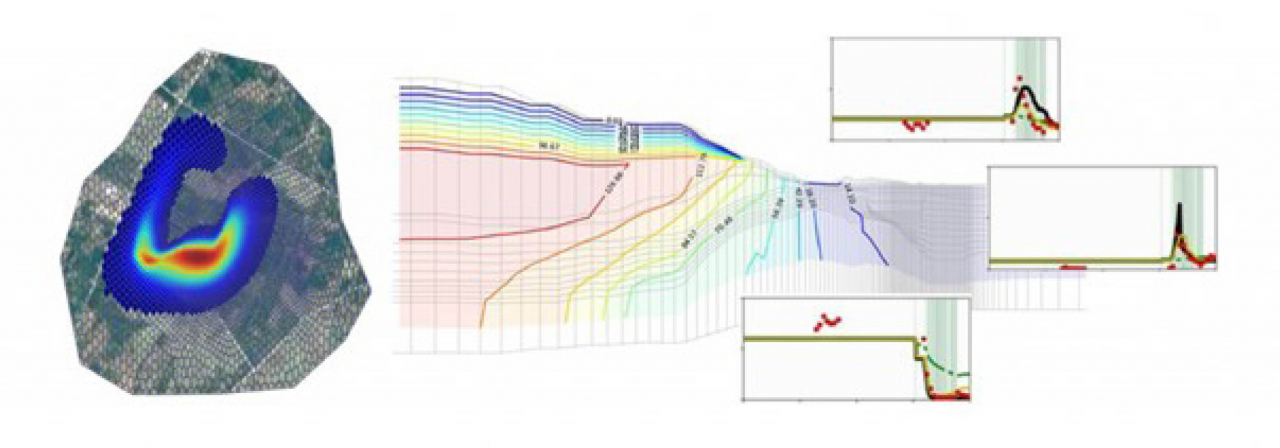

The main objective of the short course is for participants to learn through practice the modelling of reactive transport in the subsurface. Most of the time will be devoted to hands-on exercises using the provided software (Phreeqc, αRTi3D). Numerous examples will cover a wide spectrum of topics, and participants will also have the opportunity to bring their own problem.
The short course will last three days, with lectures and short exercises in the mornings and longer practical sessions in the afternoons.
The short course will provide participants with hands-on experience using the graphical user interface αRTi3D, which facilitates the modelling workflow and includes an automatic model generator allowing users to build reactive transport models in just a few clicks. Participants will explore a wide range of geometries (1D column, 2D, cross-section, radial and 3D models).
The model generator includes a reaction network builder, enabling users to intuitively construct reactive transport models without extensive prior knowledge of Phreeqc. Participants will be able to add reactions to their own existing flow models.
The topics covered will include geogenic contaminants (As, F…), nutrients, organic contaminants (BTEX, chlorinated solvents, PFAS), managed aquifer recharge, geothermics, subsurface gas storage (CO₂, H₂), metal leaching, and radionuclide transport