
L'ingénieur engagé pour
la gestion durable des ressources naturelles

École Nationale Supérieure
en Environnement, Géoressources et
Ingénierie du Développement Durable

Vous êtes ici

Dimanche 18
mai 2025

Applied Reactive Transport Modelling Short Course at ENSEGID - Bordeaux INP

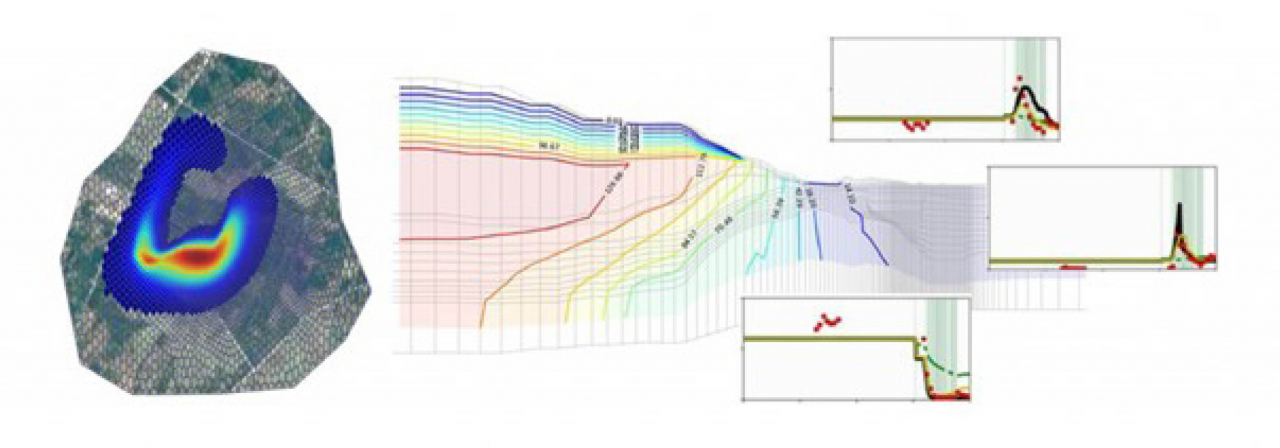
The main objective of the short course is for participants to learn through practice the modelling of reactive transport in the subsurface. Most of the time will be devoted to hands-on exercises using the provided software (Phreeqc, αRTi3D). Numerous examples will cover a wide spectrum of topics, and participants will also have the opportunity to bring their own problem.
The short course will last three days, with lectures and short exercises in the mornings and longer practical sessions in the afternoons.


The short course will provide participants with hands-on experience using the graphical user interface αRTi3D, which facilitates the modelling workflow and includes an automatic model generator allowing users to build reactive transport models in just a few clicks. Participants will explore a wide range of geometries (1D column, 2D, cross-section, radial and 3D models).

The model generator includes a reaction network builder, enabling users to intuitively construct reactive transport models without extensive prior knowledge of Phreeqc. Participants will be able to add reactions to their own existing flow models.


The topics covered will include geogenic contaminants (As, F…), nutrients, organic contaminants (BTEX, chlorinated solvents, PFAS), managed aquifer recharge, geothermics, subsurface gas storage (CO₂, H₂), metal leaching, and radionuclide transport
Applied Reactive Transport Modelling Short Course at ENSEGID - Bordeaux INP

Registration (closes on April 15, 2026)

Program

Day 1 - Monday 18 May : Introduction to Flow & Transport Modelling

Morning

  • Flow modelling (including unsaturated zone)
  • Transport modelling (solute and heat transport, sorption)
  • Introduction to the αRTi3D modelling platform and supported models

Afternoon – Example Problems: tracers, temperature, decay and sorption

  • 2D flow and tracer transport: groundwater-river interaction
  • 3D flow with an emphasis on boundary conditions
  • 2D or 3D temperature case
  • Unsaturated zone flow in a 1D soil profile
  • Radioactive decay
  • Groundwater transport with linear sorption
  • Complex sorption: PFAS mixtures

Day 2 - Tuesday 19 May : Geochemical Reactive Transport

Morning – Main Classes of Reactions with Examples

  • Classification of the main types of reactive processes and their temporal scales
  • Reactive fronts of dissolved species for fast (Toluene/O2, denitrification) and slow (methanogenesis, chlorinated solvents) reactions.
  • Reactive fronts with mineral equilibria (CO2 injection, calcite dissolution, roll-front uranium deposits, redox zonation in sediments, metals lixiviation)
  • Ion exchange and surface reactions (seawater intrusion, ammonium exchange, metals in ASR, As on Fe-oxides)

Afternoon – Examples of More Complex Reactive Systems

  • Reactive transport in the unsaturated zone and gas diffusion (BTEX/O2, pyrite oxidation)
  • CO2 balance in soils
  • Fermentation in subsurface H2 storage systems
  • Geothermal well with mineral dissolution/precipitation
  • Injection-based in situ remediation
  • Surfactant and polymer behavior
  • Methane generation and ebullition in sediments

Day 3 - Wednesday 20 May : Modelling Reactive Transport Starting From an Existing Flow Model

Morning

  • Working with unstructured grids
  • The interplay of flow and chemistry boundary conditions
  • Building the reaction network from simple exmaples
  • Coupling (viscosity, density, diffusion…)
  • Considerations related to calculation speed: time stepping, solver settings,…
  • Using PEST
  • Automation with Python

Afternoon

  • Working with participants on a model of their own choice

Practical and Administrative Information

May 18-20, 2026

Access to computers will be provided but you may also bring your own laptop. The software will also be provided (aRTi3D, free version, and Phreeqc).

The short course will be held at : ENSEGID - Bordeaux INP (France). [Campus map - research Bordeaux INP - ENSEGID]

The course instructors are :
  • Olivier Atteia – Professor at Bordeaux Institute of Technology since more than 20 years on contaminated soils remediation and modelling geochemical and remediation processes, main developer of µRTflow (solver) and aRTi3D (interface) for reactive transport modelling.
  • Henning Prommer – more than 20 years at CSIRO (AU), developer of PHT3D, more than 100 papers on reactive transport modeling, on organic and inorganic contaminants, presently associate of Ekion an electrokinetic company.
  • Dimitri Vlassopoulos – Senior consultant at Anchor (USA), since more than 20 years, specialist of in situ remediation of sediments with intense use of PHREEQC and PHT3D.
  • Leonard Botella – PhD dedicated to the study of PFAs behavior in the unsaturated zone.

Contact : olivier.atteia@bordeaux-inp.fr

Registration

The registration fee depends on the number of days (1, 2, or 3) you plan to attend. Registering for one day is not advised for most attendees unless they are already proficient in flow/transport modelling and Phreeqc. Reduced rates are available for academic researchers and students. Fees include mid-day meals for each day.

The registration deadline is April 15, 2026.

Registration

General

Academic Institution

Student

1 day

1000 €

700 €

400 €

2 days

1500 €

1000 €

700 €

3 days

2000 €

1400 €

1000 €

Registration (closes on April 15, 2026)

Publiée le
2 février 2026
Annuler